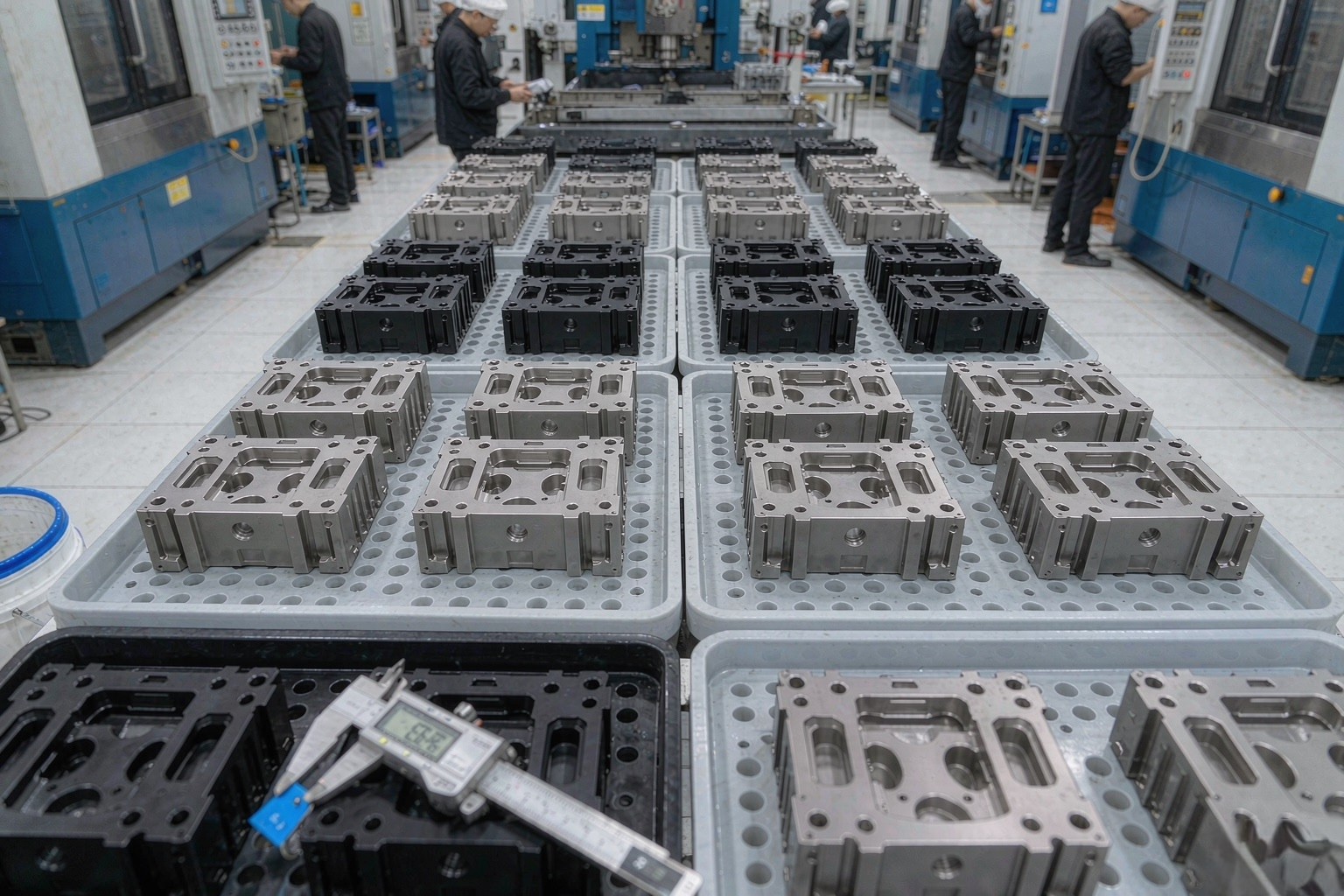
The hourly rate of a 5-axis machine is higher, but part cost is what matters. Every additional setup on a 3-axis machine adds labor, fixtures and — worst of all — datums that stack tolerance errors. Complex parts that need four or five setups on 3-axis are usually cheaper and more accurate done in one 5-axis cycle.
5-axis clearly wins in three situations: parts with features on multiple faces (housings, manifolds), contoured surfaces (impellers, molds) where simultaneous interpolation keeps the tool normal to the surface, and deep-cavity work where short tools can be tilted instead of using long, vibrating extensions.
It is not always the answer. Prismatic parts with all features on two or three faces are perfectly fine on 3-axis with a tombstone — and cheaper. Send us your STEP file; we quote both routes honestly and tell you which one makes sense for your part and volume.